Wednesday, December 12, 2012

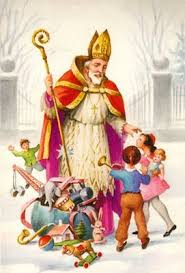
Will the real Saint Nick please stand up?

(Conversations with Jeffrey--The Series)
https://encrypted-tbn3.gstatic.com/images?q=tbn:ANd9GcSbhFfute5f6OoSyIg1Yh_q5NiNONQ0P3JvflEgdMbBsJYR9B69

“Jeffrey, you believe in Saint Nick, right?”

Grandma, remember I'm 13 now!”

“I mean the real one, the flesh and blood man whose Feast day is December 6 and celebrated by Catholic Christians all over the world.”

Don't you mean December 25th and Santa Claus?”

“Nope. At Christmas we celebrate the birthday of Jesus, although we don't know the exact date or year of our Savior's birth. I mean Saint Nicholas, a bishop of the Church, a real historical figure who lived at the turn of the fourth century.”

Exactly where did he live? I'm guessing it wasn't at the North Pole?”

“In Asia Minor in what is now Turkey, but it was a Greek province at the time. It isn't far from the Holy Land, Israel, just across the Mediterranean sea.”

So there really was a Saint Nick?”

Absolutely. Catholic Christian Churches around the world still honor Saint Nicholas as the generous, model bishop who put Jesus Christ at the center of his life, his ministry, and his entire existence.”

But where does the name 'Santa Claus' and his story come from?”

'Santa' means 'saint' and 'Claus' came from shortening the bishop's name 'Nicholas.' Some say that early Dutch settlers in New York brought their tradition of 'Sinter Klass' to America and that started the tradition here.”

Tell me again what a 'saint' is?”

The word 'saint' means 'holy.' Saints are just ordinary people who want to live like Jesus taught us to live, but they are special because they did a good job at it. The apostle Paul calls all Christians 'saints' in his writings.”

They're sort of like Catholic Christian heroes, right? Like role models?”

That's the idea. We consider them examples of how we too should live pleasing to God. Because they are still alive in Heaven, no matter how long ago they lived on earth, we can ask them to pray for us.”

What connection does this real Saint Nick have to the Santa Claus story today.”

“The Santa Claus story sort of grew in people's imaginations through the centuries since the real man lived who was named Nicholas, the Bishop of Myra, a southern seaport in Turkey. Even the way the modern Santa Claus is dressed came from the real Saint Nicholas. Bishops of the Church always wear red and Nicholas was a bishop. Today's Santa and his 'helpers' are always dressed in red. Starting in 1931 (when Grandma was only six years old!) the Coca-Cola company started using a caricature of the real Saint Nick for their advertising.”

What's a 'caricature'?”

“It's like a cartoon, an artist's way of exaggerating certain features of the real person.” 

Do we know anything about Nicholas as he was growing up?”

“Nick was the only child of very rich parents who died in an epidemic when he was a young boy. He grew up in a monastery and became a priest when he was 17. He inherited his parents' wealth and used all of it to help poor families, widows, and especially children and orphans. He became famous for his generosity and kindness and giving of gifts.”

How long after Jesus' resurrection did Nicholas live?”

“About 280 years. The Christian Church was just getting started, but faith in Jesus was spreading fast all over the known world of that day. During Nicholas' life the leader of the country, Emperor Diocletian tried to destroy the Church with his political power. One of his advisers was the son of a witch. The Emperor worshiped pagan idols, burned writings about Jesus, and forced priests to renounce the Christian faith or face death. He forbade Christians to meet together or hold any government office. As a bishop and their leader, Nicholas was the main target for his persecution.” 

Did this stop Bishop Saint Nick and all those new Christians?”

“The emperor arrested him and had him tortured for disobeying the new laws. Actually, the real Saint Nick must have been very skinny, unlike today's Santa. He spent more than a decade in prison being starved and also fasted often when he was free. Emperor Diocletian was eventually defeated, and his kingdom collapsed. Constantine, who became the next emperor, was favorable to the Christians, so Saint Nick finally got out of jail.”

Did everything go smoothly for the Christians then?”

“There was trouble. Some who called themselves Christians but didn't believe exactly what Jesus and His apostles taught caused confusion. Nicholas was known for his courage to stand firm for the true Christian faith. He lived it and taught his people well. He was against the heresies of those times.”

What's a heresy?”

“It's a teaching that is contrary to what Jesus and his followers clearly taught. The main heresy in Nicholas' day was led by a man named Arius from Egypt. He tried to convince people that Jesus was not really the Son of God, maybe just a prophet or only a top angel—'sort of a lord' but not equal to God.”

How did that all get settled?”

“In those early first centuries after Jesus' resurrection when all the new Christians were forming their common beliefs, they settled important matters of the Christian Church by calling a Council of all the bishops. The first one ever was called by Emperor Constantine during the time of Bishop Nicholas. It was held in Nicea in 325. More than 300 bishops from all over the Christian world attended, including Nicholas. Their conclusions are what we declare in the Nicene Creed that we say every Sunday at Mass.”

Did our Saint Nick stand up against this Arius fellow?”

“Bishop Nick got so angry with Arius at the Council for saying such things about Jesus, that he belted him—he hit him with his fist and knocked him down!”

Wow! What happened to Saint Nick?”

“For doing that, the Emperor took away his vestments and his bishop's credentials and threw him in prison. The story goes that Jesus and his Mother appeared to him in a vision in prison and reinstated him as the bishop.”

What kind of gifts did our Saint Nick give to people?”
“Legends say that Saint Nick always wanted to help people anonymously. He didn't want to draw attention to himself. On one occasion he heard that a certain poor man had three daughters who wanted to be married. But their father didn't have money for a dowry so Bishop Nick secretly helped him out.”

What's a dowry?” 
 
“In those early centuries, a young woman's father had to offer a prospective husband something of value called a dowry. Without a dowry, she was not likely to marry and might have to be sold into slavery. On three different occasions, so the story goes, Saint Nick threw gold coins through their windows where they landed in stockings hanging by the fireplace to dry.”

Could that be where the custom of filling stockings at Christmas came from?”

“Probably. He is also known for saving three innocent condemned prisoners who were blindfolded and ready for the executioner's sword. Nicholas fearlessly grabbed the sword, cleared them of the unjust charges, and the men went free. Saint Nick is widely known as the patron saint of children. There are other stories of him rescuing children from danger after they were kidnapped or missing. There is a scary one about three little children lured into the clutches of an evil butcher. At another time three theological students were murdered by an innkeeper and their bodies chopped up and hidden in a pickling tub.”

That's gross, Grandma. Is it true?”

“Who knows? Stories grow bigger with the retelling. Saint Nick was said to have restored the dead students to life. He had a strong concern for justice, especially for innocent condemned prisoners. Also for intervening in favor of people unjustly jailed, which was common in those days.”

He must have been quite an aggressive man.”

“You could say that, but it was always to defend the true faith of Jesus. The real Saint Nick also destroyed many shrines to pagan idols, drove the demons away, and built churches in their place. He so totally destroyed the most beautiful and famous pagan temple dedicated to the goddess Artemis, who was the Roman equivalent of the Greek goddess Diana, that not one stone was left in place. Thousands of churches all over the world are named in honor of Saint Nicholas.”

Did Saint Nick ever get to the Holy Land?”

“He went there on a pilgrimage. On his way back, the story goes that the ship he was on and the sailors were protected when he prayed, like Jesus did, for God to calm the storm. Many seaports especially in Greece, since Nicholas was Greek by birth, erected statues of him surrounded by small ships made of silver or carved from wood. Sailors even now ask him to pray for their protection. Instead of wishing one another luck, they say, 'May Saint Nicholas hold the tiller.'”

Is Dec. 6th Saint Nick's birthday? How did the idea of giving gifts get shifted to December 25th ?”

“Dec. 6 is the day he died. Saints' days are always commemorated on the day of death, the happy day of their entrance into eternal life. In Europe it was on Saint Nicholas' day when gifts were given. At that time gifts were mainly nuts, apples, and sweets put into shoes left beside beds, on windowsills, or before the hearth.” 

Where did the idea come from that Santa comes down the chimney?”

“Well, that certainly didn't come from the days of the real Saint Nick. Did you know that chimneys weren't even built on houses in those days? Chimneys didn't come into use until the 13th century when they were constructed in northern Europe.”

A lot of the early Santa pictures you showed me have a hooked staff behind him in the sleigh. What's that all about?”

“That custom did come from our real Saint Nick. It is called a 'crozier' and is always carried by a bishop even now in our Churches. It represents a shepherd's staff since a bishop is to be the shepherd of his people, as Jesus is the Good Shepherd.”

Bishop Loverde carried a crozier like that when he conducted our Confirmation Mass.”

Did you notice that in some pictures of Santa today he is carrying a big book? In some European gift-giving traditions the large book represents the record of children's behavior—Santa is checking if they were 'naughty or nice.' But the big book we see at Mass from which the priest or the lector reads is the Book of the Gospels or the Holy Scriptures.” 
 
For today's Santa, where did the idea of the sleigh and reindeer come from?”

“It took generations before the tradition settled on Santa coming on Christmas to bring gifts. In 1821 the first, small, lithographed book was published in America titled The Children's Friend. A 'Sancte Claus' (in German, 'Sankt Nicklaus') was pictured with a red beard arriving from the North in a sleigh pulled by one sort of exhausted-looking flying reindeer. They were shown landing on a roof by a chimney. Santa began to be thought of as rewarding good behavior and punishing bad. Gifts were mostly safe toys, dolls, and books. The sleigh even had a bookshelf! From then on the tradition shifted away from the real Saint Nicholas celebration to Santa coming on Christmas eve.”

Grandma, that long-ago picture shows Santa as a tiny man not the big guy in pictures we see now.”

“That was still the idea two years later when Clement Clark Moore wrote the poem 'The Night Before Christmas' for his six kids. The way the author imagined Santa was 'chubby and plump, a right jolly old elf' and his sleigh was miniature. The description stuck and the poem became famous.”

Where did that long clay pipe and all the smoke Santa blew from it originate?”

“The traditional pipe was from the Dutch, who were known to be heavy smokers. It wasn't until the end of the 1920s (when Grandma was in kindergarten!) that the American Santa began to be pictured as a normal-sized old man but with a hugely fat belly.”

And his original red beard has became all white and long to match the fur trim on his suit. He has a fat, white mustache, rosy cheeks and twinkling eyes.”

That's the way the story goes. And he wears snow boots, a wide black belt, and a long-tailed ski cap. But Bishop Saint Nick's hat was called a 'miter,' the special tall, pointed hat of his appointed office.”

And I guess he likes Coca-Cola, or hot chocolate, and cookies that people leave by the fireplace for him!”

“Now he owns eight reindeer (nine, if you count the new Rudolf with the red nose!) and a bunch of elf assistants who are busy making toys all year. And the toys are really high-tech now!”

That doesn't sound much like our original Saint Nick.”

“Santa Claus, for some, replaces the Babe of Bethlehem; the real Saint Nick points us to the real Babe of Bethlehem. 
Today's Santa is pictured as flying through the air from the North Pole; Saint Nick walked the earth caring for those in need. 
Santa, as we know him, was brought on the scene to boost commercial Christmas sales; Saint Nicholas brought the message of Christ and peace, goodwill toward all—the real Christmas story. Santa belongs to childhood fantasy; Saint Nick is still a Christian model for all of us.”

Wednesday, December 5, 2012

Counting on my Catcher

Practice makes perfect--TRUST

Trapeze artists offer a beautiful image of trust. Flyers have to trust their catchers. They can do the most spectacular doubles, triples, or quadruples, but what finally makes their performance spectacular are the catchers who are there for them at the right time in the right place. Much of our lives is flying. It is wonderful to fly in the air free as a bird, but when God isn’t there to catch us, all our flying comes to nothing. Let us trust in the Great Catcher.     
Fr. Henri Nouwen

And God inspired Saint Paul to express it in this reassuring way:
“And we know that in all things God works for the good of those who love him, who have been called according to his purpose. For I am convinced that neither death nor life, neither angels nor demons, neither the present nor the future, nor any powers, neither height nor depth, nor anything else in all creation, will be able to separate us from the love of God that is in Christ Jesus our Lord.”
Romans 8:28, 38 – 39

Trust is a hard and difficult concept for me. Maybe it stems from my childhood or maybe from aging or being gun shy after many failures. Or maybe it is from my own reality as a person as I am learning, re-learning and unlearning many things about the life, the heart, faith and God.

Trust has to do with relying on the integrity of Someone or something, like when I drive across a bridge I trust that the structure will hold. But trust in the seen is a far cry different from trusting in the Unseen.
I trust Jesus, I do, but I am human and in my more humane moments, my trust is fragile, even in the face of evidence to contradict my lack of trust and faith. Time and time again God has shown himself in love and tenderness by meeting needs and pouring out Grace in my darker, more fragile moments.

Trust is indispensable to faith in Jesus. I must trust Jesus at his word, even though I cannot see him face to face in his bodily form. But with trust, I do see Jesus daily: in the eyes of wounded people facing their pain boldly and head on; in the distressing disguise of the poorest of the poor; in the sentient beauty of the mountains that surround my world; in my quiet moments. I do see the Word become flesh and in and around me daily.

Trust comes when I ask for the eyes to see in the dark, my own darkness to be precise, the glory of the Lord and his love.

Trust comes when I pray for wisdom and then without thunderbolts and lightening, I simply make a choice, trusting that God is working deeply in the midst of my choices, regardless of whether I see or feel God.

Trust comes when I take leaps of faith. It is knowing that when I risk all, one of three things will happen:
either I will be caught when I fall;
 I will sprout wings to fly;
 or I will not be broken if I land too hard.

Trust is accepting God's unconditional love. It is saying to God, “I know You love me, like no other, and You will always be there…You will never forsake me, even if I forsake myself.” Trust is knowing Jesus says to me daily, “I will never, ever, leave you or forsake you.”

                   Guest post from “Earthy-monk” (Excerpts)

Friday, November 30, 2012

Our Lombard Street and “24-Zig”

WHAT DOES THE NEXT YEAR HOLD FOR US?

San Francisco is famous for its hilly streets but Lombard Street used to take the prize for being the most treacherous drive until it was re-engineered to make it safer. Previously, when it was a steep straight street, it was a one-way death-defying drop toward the San Francisco Bay. Engineers gave it a series of hairpin S-curves within the space of one city block. Low, walled gardens were built, projecting from the sides of the street into the center, creating 4 right-hand and 4 left-hand S-curves—a total of 8 from the high top to bottom. Maximum speed? Only 5-10 mph. You now spend as much time going sideways as you do going downhill—but at least you arrive in one piece!

A part of the famous Burma Road carved from the mountainous jungles in the late 1930s, “24-Zig” has 24 zigzag turns in the road in the space of 2.4 miles—one S-curve every one-tenth of a mile. From the air, it looks like a long piece of wet spaghetti laid out with 24 perfect hairpin turns running along the top of the mountain ridges. You actually travel 10 miles in order to complete 2.4 miles. Most of the time you are going sideways.

Google's map function will take you visually to both of those spots. Isn't the Internet fascinating?

We may fret at the slow pace of our life journey and the sideways directions seem to be a waste of time. Nevertheless, God seldom takes us to His destination by a straight street, for good reasons known only to Him. The zigzags may be frustrating and confusing. It would be nice to have a heaven's-eye-view of our lives from beginning to end. Not possible. Faith and trust in God is our only recourse. “We live by faith, not by sight.” (2 Corinthians 5:7) So let's allow God to be our GPS for whatever roads we must travel in the year ahead!

There may be some steep hills to climb.
Some times where the road seems treacherous
and you aren't sure which turns to take.
Times when you feel like you are on the brink of falling.
And there may be many curves in the road
as you make your way through the ups and downs of the coming year.
May you know God's presence with you through each tunnel,
every steep climb, every curve
in the beautiful mountaintop experiences with Him,
and also through the slippery storms of life.
May He walk with you down through the valley and up the mountain,
take your hand and guide you through to His Light,
put a hedge around you to keep you safe,
help you to find joy and excitement in the roller coaster ride,
and fill you with amazement at the beauty He provides along the way.
Take time to smell the flowers,
to admire His handiwork along Life's railway.
And may His love flood over you, fill you, and overflow in praise
to Him for all He's done, does, and will do! Amazingisn't He?

Worrying does not take away Tomorrow's TROUBLES
It takes away Today's PEACE.

Wednesday, November 21, 2012

DRIFTING OFF KEY?

Drifting can happen in music and in life.

I had a gifted friend in our vocal music class in high school who would begin singing right on pitch but would invariably drift off key. Part of her problem might have been that she was not listening to herself or her hearing might have been impaired. Drifting in our spiritual lives can happen in any season of life, but in our latter season it seems to become more common.

Scripture mentions drifting. “...We must pay much closer attention to what we have heard lest we drift away from it” (Hebrews 2:1).

Drifting in the natural world implies being carried along by wind or current. We can visualize it as the movement of a boat when loosened from an anchor. Quietly and unnoticed, it will drift downstream floating aimlessly. 

Spiritually, drifting is what we used to call “backsliding” in the evangelical world. A person once fervent, strong, and bold in his beliefs and witness unobtrusively seems to have become lukewarm and withdrawn. He begins to deviate from God's purpose which formerly impelled him towards God's intended goal. He has slipped away from God Who has been his Anchor and soon finds himself at a distance downstream.

Scripture uses other terms related to drifting: “falling away, being carried away, wandering, tossed here and there by waves, being led away, going astray, carried about by every wind of doctrine, driven and tossed.” In most cases those words are directed to believers, to Christians. Since God has created us with free will, we can decide to change course or unless we are careful, drift off course. If we stop pressing on spiritually, drift is inevitable because of the drag of the current of materialism and the secular culture.

As I advance in my latter years it is easy to let my guard down, to drift morally, and grow slack in my full obedience to the Lord. It is possible to disgrace Him at the end of my life. By such a drift I could undo all the good and positive reputation and witness for God of my earlier years. In the book of Revelation Jesus is recorded as calling such a drift "losing your first love" and His command is to remember from where you have fallen and repent. Jesus declared He would rather we be cold or hot than lukewarm, tepid, or halfhearted.
 
In the context of our mature years, what could possibly cause us to become spiritual driftwood washed up, as it were, on the shores of life after we have been faithfully fervent and effective in our Christian lives? Are any of us immune to such a possibility? The latter season of our lives carries its own special temptations and influences. We may have become physically tired, exhausted, weak and weary with the length of our journey. Our knees buckle and our arms hang limp both physically and spiritually. The pressure of circumstances, the loss of beloved relationships, loneliness, being forced to downsize our living situations—these and many other factors may contribute to discouragement and depression which leads to spiritual drifting. 

What is the remedy for drifting? Aside from any adverse circumstances, I can drift spiritually when I am not careful to maintain my connection with my Anchor, God, and with others in the community of faith. The New Testament letters are full of admonitions to “hold fast” and to “stand firm.” The term is repeated again and again. I need to continually “draw near to God and He will draw near to you.” Such an intimate relationship keeps the fires of “first love” burning.

The instruction of Hebrews 2:1 is all the more pertinent in my older years. I must “pay much closer attention” even than I did in my younger and mid-years. As a long time follower of the Lord for decades and scores of years I dare not regard God's Truth as “same old-same old” that I have heard so many times before. Stale listening is a particular temptation. Perhaps I need new spiritual “hearing aids.” The Holy Spirit has fresh, new ways of speaking God's ancient truths to me in my advanced years, if I remain eager to hear them. 

God wants me to keep singing enthusiastically while I am at the summit of my life journey and not drift off key. This life is a dress rehearsal for my Life To Come. I want to sing my way Home on perfect pitch.

Tuesday, November 20, 2012

“Quah-kah-ka-num-ad”

(Excerpt adapted from Ch. 11 of my recently published book “Living the Treasures in the Land of MORE”) In the celebration of feast days in the Church's liturgical calendar, Saint Rose Philippine Duchesne is today's “Saint of the Day.”

“Woman-who-prays-always.”

Those words above are translated from what the Potawatomi Indians called the strange elderly nun who came across the ocean to teach them about God. 
 
Born in France in 1769 and growing up in the midst of the French Revolution, Rose Philippine Duchesne spent many years caring for the sick and poor, helping fugitive priests, visiting prisons, and teaching the faith to destitute children. All the while she prayed for the day she might go abroad as a missionary. It seemed her hopes would never be realized. 

Time passed. Finally at the age of fifty Rose enthusiastically answered the bishop’s call for nuns to go to the United States as missionaries. It took 11 weeks to cross the ocean and another 7 weeks on the Mississippi before she arrived at her destination in Missouri.

During the rest of her life in pioneer America, she built a convent, orphanages, parish schools, schools for Indians, a boarding academy, and a novitiate for her order. All the while suffering threat of Indian massacres, poor health, crude and cramped living quarters, shortages of food, water, fuel, and money, forest fires and blazing chimneys, severe climate, and total lack of privacy. At the age of seventy-two she founded still another mission school for Indian girls and nursed the sick until her death at eighty-three. 

Unable to learn the Indian language at her advanced age, she was best known for praying while others taught. Her many active works may have disappeared in the passing of generations, but her intercession for the people she encountered is even now bearing eternal fruit. 

In my advanced age, I don't endure the privations under which Rose served God. But I too want be make myself available as a “Quah-kah-ka-num-ad.” When my friends, my family, even virtual strangers, or those with little Christian background ask me to pray for them, as they so often do, I hope to be “instant in prayer, in season and out of season.” I too can no longer realistically expect to pursue the active works in the harvest field which I had the opportunity to do in years past. Nevertheless, while others teach and work, behind the scenes I can pray. 

I can imagine that if Rose lived in my generation, she would have made full use of modern communication. But her prayers were not hindered for lack of technology. I do live in a high tech age. So I want to respond by praying immediately, and when appropriate even write my prayer by e-mail. I’m confident that as I send off my prayer through cyberspace it is simultaneously transmitted by Angelic Messenger Service in less than a nanosecond to Our Father Who is in Heaven. Thank You, Holy Spirit, for Your editorial blue pencil to make my prayers instantly good and acceptable and perfect before they reach God!


Monday, November 19, 2012

SOBRIETY CHECK POINTS

A flashing light up ahead....

Law enforcement sets them up around holidays intending to catch substance abuse drivers. Most of us don't mind such traffic delays since they help to prevent accidents.

Life also has sobriety check points. They are reality checks. God may be behind them working out His loving purposes for our good.

It might be the sudden death of a loved one; we become acutely aware of our own mortality. Or a doctor's serious prognosis; life as we have known it will drastically change. Perhaps a simple notice in our mailbox that we have arrived at the AARP age; it's time to reshuffle our dreams and goals. The graduation of a child—or a wedding—or a milestone birthday. Maybe a near accident that leaves us shaken. The deterioration of our health or becoming aware of the diminishing of our mental powers. Or a hard look in the mirror. A catastrophic storm that leaves our prized possessions in shambles. A poor investment or a financial crash that wipes out our life savings; we face a new normal. A spouse suddenly deserts the family. A job loss. Simply stepping on the bathroom scale may be a sobering shock for some. The list of potential taps on the shoulder is long and unique to each of us.

Without these sobriety check points in life we tend to drift along. As negative as they may seem, they force us to face reality and may give us time to correct our course. “So teach us to number our days that we may present to Thee [Lord] a heart of wisdom.” (Psalm 90:12)

Tap on the Shoulder

God tapped me on the shoulder.
Busy, distracted, I postponed:
“Wait a minute.”
Time slipped by.

Detoured by trivial, temporal tasks
I deferred: “Later.”
Time dashed by.

Disguised as urgency
I mistook activity as priority
but it was not of the essence
of eternity.
I put God off again:
“Another time.” But
time flew by.

Dismayed with life's futility
distraught by mundane toil
distressed by swiftly fleeting days
I realized then
that time was running out.

Finally, God got my attention
by reminding me
through my fragility
of my own mortality
and dispensability.

God pursues me
relentlessly and lovingly
through blessing me generously
or through affliction and adversity
however necessary
to turn my heart
to Eternity.


Thursday, November 15, 2012

Leona a.k.a. "SAL"

It's short for SALmon!


I don't remember how it started, but among friends for the past year I have been signing “Sal” as my informal signature.  I refer to myself as “God's SALmon still swimming/leaping upstream in life, only somewhat more slowly due to chronological factors.” The main factor being my current age of 87.
A little background on the salmon analogy first.

Alaska salmon have a most interesting life. One that takes them from the rivers and streams of Alaska's wild frontier an incredibly long distance to the high seas of the Pacific Ocean—and back again. In fact, right back to the very place they were born. They find their way from the immensity of the ocean by their amazing created instinct from God. Salmon swim from fresh water to salt water and back again!

Hatched from small eggs in a stream bed, their journey downstream towards the ocean takes a couple of years. After that, they head out to the salty ocean for up to 4 more years. They swim and feed more than 2000 miles throughout the northern Pacific Ocean. Their journey is hazardous at every point as they are constantly hunted by seals, whales, and fishermen. 

When fully mature, the adult salmon will swim back to their original stream or river re-adapting to fresh water. Downstream was relatively easy; returning upstream dangerous and requiring great strength and risk. They swim against the strong current through rugged rivers to leap up miles of rapids and rocky waterfalls, traversing fish ladders, avoiding nets and hooks of fishermen, and staying clear of fierce and hungry bears. 

Those that survive and finally reach their natal stream breed and lay their eggs. Their life cycle is complete. After spawning they generally die within a week or two, fertilizing the stream and creating a nutrient-rich environment for the new infant salmon that are about to hatch.


An analogy to myself?

I too have been on a long adventurous life journey of many decades in various geographical scenarios and under challenging conditions both physical and spiritual. 

Obstacles and hazards and adversities have been overcome or have passed
 or I am accepting and managing them with the help and strength of our loving
 God. I hope I have matured in wisdom while I have been weathered by the
 different seasons of life and shifting circumstances. At times I felt that the 
change from life's fresh waters to salty waters was impossible. But one adapts.
 And God brings me back to refresh me with abundant fresh water blessings 
again. 

Violent bear and whale attacks both material and spiritual have been frequent
 of my life. The hooks of the enemy often came too close. The battles have been
 fierce but not terminal—some wounds and scars remain. It seems that I've often
 had to swim against the current; at times also in deep waters and stormy seas. 
The distances to accomplish the goals of my life which I've felt the Lord gave me 
often seemed daunting. Sometimes I have lost direction in the vast ocean of life. 
Time and again God helped me readjust my compass to align with His will and I
 was on my way once more to the destination He planned.

At times I've been exhausted, worn and weary by the length of the life's lonely
 journey. Retirement beckoned invitingly. Why not stay in the perceived shelter
 of the ocean and drift with the tide to some easier Finish Line? Swimming 
upstream and leaping rapids is just too difficult anymore. That's meant for the
 young. Been there, done that.

Nevertheless, the vision and destiny which God planted in my heart from my
 youth, like the inborn instinct of the tiny salmon hatchlings, impelled me to 
first head downstream into the thick of ocean life in my prime years, and then
 in maturity to struggle upstream again. “I press on [keep leaping upstream] in
 order that I may lay hold of that for which also I was laid hold of by Christ 
Jesus.” And I press on [keep leaping upstream] toward the goal for the prize of
 the upward call of God in Christ Jesus” (Philippians 4: 12,14).

As long as God generously provides for me His life and breath and strength 
and opportunities through my spoken or written or published words, I will
keep leaping the rapids. In these days of my maturity I want to be faithful 
wherever and however and whenever I can to reproduce the Christ-life in others.
That is my calling. And God's calling has no expiration date—it is for a lifetime.
 There is no retirement program if one's focus is to do the will of God “on earth
 as it is in heaven.” It's a joyous upstream adventure all the way!

By signing “Sal” I guess I remind myself of the Lord's continuous upward call on my life without respect to chronological age.