Saturday, January 19, 2013

WISDOM—my “word” for the year

Or a good word for “the rest of my way” to the Finish Line.

At the beginning of each year I give some thought to choosing a word to focus on for the next lap of my life race. This year Wisdom is that word. 

Wisdom is needed in every season of mortal life. But in childhood it can't be attained; life has not unfolded yet. We are too fresh. Youth is the experimental period; life is being tested, knowledge is being accumulated. Wisdom? Not so much. In prime years wisdom and folly are being sorted out; some good choices made, some foolish decisions take you on detours.

It's in advanced years that wisdom is expected to flower and its fragrance waft to others. At least that's the proverbial track. The mature, the elderly, the aged are supposed to finally be wise, and those who trail behind are expected to happily benefit from their collected experience. That's not always so. Sometimes, unfortunately, the aged are foolish. And the young want to make their own mistakes, reluctant to profit from anyone else's experience. So history repeats itself. The hopefully wise should dispense their wisdom only if it's requested. Otherwise, zip. That in itself is wisdom.

Not to be selfish but to be discreet, the wisdom I seek for myself in my mature years is wisdom to live in the will and purposes of God, to choose and act prudently as the path of life narrows and the remaining days can actually be numbered. In my youth, the days stretched open end and could hardly be numbered.

The aging Moses reflected on this transient life in Psalm 90: “So teach us to number our days, that we may present to Thee a heart of wisdom.”

I likewise have reflected on this reality in my Prayer for Wisdom:

  • God, grant me the wisdom of mature years, to circumvent the foolishness of aging.
  • When You see me playing in the spiritual shallows, Lord, beckon me out of the wading pool into Your deep waters.
  • If I feel bogged down in meaningless routine, turn the plain water of my daily life into “the best wine saved until last.”
  • When I tend to resist change and settle in my comfort zone, grant me an open spirit and a growing, receptive mind.
  • If I’ve lost my get-up-and-go, show me how to “rise and take up my bed and walk.”
  • When my leaves are withered and dry, revive me to be “full of sap and very green.”
  • When my fruit is scanty and sour, show me how to “flourish like the palm tree”
  • If the embers of my first love for You are growing cold, fan them into flame by Your Holy Spirit.
  • When the noise of my activity drowns out Your still small voice, quiet me to wait on You in contemplative silence.
  • If the soil of my life is depleted and lies fallow, break up the clods, supply fresh nutrients, and make straight my furrows.
  • When my prayers seem unanswered and my spirit is arid, open the floodgates to let Your Rivers of Living Water flow again.
  • Where my life is out of balance and I lose my footing, help me restore eternal priorities to keep from stumbling.
  • When my vision for Your Kingdom has grown dim, touch my eyes to see again Your destiny for me.
  • If I’ve become slow of speech to declare Your message, open my lips to boldly proclaim Your Good News.
  • If I can't hear Your voice clearly, send Your Holy Spirit to be my hearing aid.
  • If my memory begin to slip, help me remember that You never leave me or forsake me.
  • When I’m weary from the length of life’s journey, draw me close to Your bosom to find comfort and rest.
  • If I’m laboring to bear scarcely 30-fold fruit, teach me to abide in You to effortlessly produce by Your wisdom 100-fold.
  • Where some good seed of Your Word still lies dormant as I advance in years, send the gentle latter rain of Your Spirit so I can bear an abundant late harvest.
  • When I am tired and lack motivation to press on, restore iron to my soul, strength to my weak knees and limp arms.
  • When I drag my feet to do Your will, energize me with the adrenalin of Your Holy Spirit.
  • When I’m short of breath from life’s fast pace, inflate my lungs with Your Breath of Life.
  • If I grip material possessions too tightly, teach me to hold loosely the things of this world.
  • If I open my mouth to speak foolish words, show me how to put a watch on my lips.
  • When I’m afraid of the darkness around me, take my hand to walk in Your Light.
  • When my emotions roller coaster out of control, teach me to set my affection on things above not on things of earth.
  • When anxiety about the future threatens to overwhelm me, remind me of Your great faithfulness in years past.
  • If my appetite becomes jaded by the world’s junk food, give me Yourself as my Daily Bread in the Eucharist.
  • When I think I’ve reached the limit of my endurance, help me persevere in Your strength to run the last mile Home.
  • When thoughts of my mortal end cause me fear, remind me that You are preparing a place for me in Your Father’s House.


AM I AN “EZER”?

Guest post by Carolyn Custis James (www.whitbyforum.com)

The LORD God said,
"It is not good for the man to be
alone.
I will make an ezer
(helper) suitable for him."
Genesis 2:18


Three A.M., and my life was about to change forever. I was wide-awake. No, I wasn’t tossing and turning in my bed. Bed was the furthest thing from my mind. Oddly enough, I was pouring over books, smuggling volumes out of my husband’s study, searching for answers. I felt like a detective and I knew I was onto something.

For years I’d been troubled by interpretations of Eve that left me (and a lot of other women) out in the cold. I could relate to what one single woman confided, as she tried to fit in, “I don’t mind being called a helpmeet. I like helping people. But helpmeet doesn’t encompass everything about me.” Little did I realize that the “helpmeet” version of Eve was about to topple and something better—for all of us—would take her place.

What is God's Blueprint?

My attention zeroed in on the word God used to describe the woman when he created her. Ezer (usually translated “helper”) has historically been defined in terms of marriage, motherhood and domesticity. According to this line of thinking, a woman fulfills her highest calling when she marries, bears children and manages the home.

Wonderful and significant as marriage and motherhood can be, this definition creates serious problems for all women.

When we are little girls, God’s purposes for us are pushed out into the distant future, to the day we don a wedding veil and head for the marriage altar. It intensifies the difficulties of singleness and the heartache of childlessness. Elderly women are troubled by the thought that God’s purpose for them has expired. Like Cinderella’s stepsisters, we end up trying to squeeze ourselves into a creation blueprint that simply doesn’t fit us all.

As I studied through the night, my curiosity was fueled by a deep longing to know if God’s blueprint included me. Is God’s blueprint for us really too small?

A Warrior For God’s Purposes

The word
ezer appears in the Old Testament twenty-one times—twice for the woman in Genesis 2:18 and 20, three times for nations Israel turned to for military assistance when they were under attack, and sixteen times for God. This information resulted in upgrading the ezer from “helper” to “strong helper” and led to a divided (and at times heated) discussion over the word strong. How strong is strong?

I decided to look up the references. To my surprise,
I discovered powerful military language in every passage. Whenever ezer appeared—for the three nations, obviously, but also for God—it was always within a military context. God is His people’s helper, defender, deliverer, sword and shield. He is better than chariots and horses. He keeps sentry watch over his people and with His strong arm overthrows their foes. Based on the Old Testament’s consistent usage of this term, it only makes sense to conclude that God created the woman to be a warrior.

Further reading uncovered additional evidence of the strength and significance of the
ezer. I discovered that the original inventory was off. Ezer shows up more than twenty-one times and in the most unexpected places. You just have to look more closely to find it.

Reading through one of those tedious genealogies (the passages we tend to skim when reading through the Bible) I spotted
ezer again—in men’s names. Ezer was one of Judah’s male descendants. Moses named his son Eli-ezer. Abi-ezer belonged to the elite band of David’s mightiest warriors. Samuel raised a monument to God’s glorious deliverance and named it Eben-ezer.

Even today, the name
Ezer still carries a lot of weight. Ezer Weizman was an Israeli military hero, a world leader who served as Israel’s seventh president. I doubt if anyone made fun of a man like that because his parents named him Ezer.

Ezer represents the strength and valor of a warrior. God created women to be warriors. “It is not good for the man to be alone.” Our brothers need us, and God calls us to join forces with them in advancing His kingdom wherever we are.

The Perfect Fit

That night, while the rest of the world slept, my identity changed forever. I couldn’t think of a single moment, situation or relationship in my life where my calling as an ezer-warrior for God’s purposes didn’t apply.

My three little nieces are just starting out in life, but they are ezers too. I regularly hear from moms engaged in fierce battles for their kids. A young single is battling for the souls of women in Ghana, as another woman launches a new consulting business on the home front. A friend of mine faces huge challenges in his business and is stronger and wiser in his own battles because of his ezer-warrior wife. A ezer in her nineties ministers actively to lost souls in her extended care facility.

We are all ezers—from our first breath to our last. We follow Jesus, and He calls us to advance His kingdom no matter where He puts us. Warrior covers all of who I am.


Thursday, January 3, 2013

Jesus in my boat

THOUGHTS AT THE MILESTONE OF A NEW YEAR

For eighty-some years of my life I've earnestly desired to stay in the midstream of the River of God's Will. Each morning I declare to the Lord that I'm committed to do His will “on earth as it is in heaven.” That is my life habit. Do I carry it out perfectly?

Of course not. In my humanity, with regret, at times I've steered my life “boat” toward one river bank or another, let it drift backward, or veered off course and miserably failed. Nevertheless, God, in His love and mercy, always brings me back to His midstream. He is my spiritual GPS—to the extent that I not only hear His voice but obey it. If so, I stay on course through stormy weather or treacherous white rapids. My frail bark has often stalled on some sandbar. But if Jesus is in my boat—and He is—He will rescue me again and set me back on course.

At the threshold of each new year I schedule a personal “time out” from my regular routine and engage in a kind of self-examination. I need to collect or gather together the scattered pieces of my life as it is now, in order to correct my course if necessary, to better redeem whatever earth-time is left for me. 

I have to chuckle—I learned an enhanced definition for the word “recollection” when I became a Catholic Christian. I read an announcement in the Church bulletin that an annual “Day of Recollection was scheduled for the women of our parish. I was puzzled; would we all sit around and talk about our memories? That seemed strange. I found that the purpose and agenda, however, was something like a spiritual retreat. Setting aside a day to concentrate on the presence of God without distraction, to look at Him and adore His attributes. To meditate on Scripture truths. It was to be a time to gather up our faculties, our spirits, and bring them back into spiritual balance. We were to come apart and simply gaze at the wonder of God and His love and discern how He wanted to work in our lives. 

 That's exactly what I wanted to happen in my new years “time out.”

To be honest, I need to have such a “time of recollection” every day. To present myself to God, to sit quietly, focused on Him alone without distractions. “Here I am, Lord. If you want to speak to my inner spirit, I'm listening.” There are other times I schedule Bible study and praying for others. This is not it. This is a special time to simply enjoy being together with my Lord. A time to listen to God's voice. A time to gather up the scattered puzzle pieces of my life and let Him show me how to put them together like the perfect picture on the top of the jigsaw puzzle box of my life. 

We are blessed that our parish provides a lovely Adoration Chapel for such times of silent contemplation. Parishioners voluntarily sign up to be present for designated hours so that someone is always there to worship Jesus 24/7. But in addition to taking advantage of that opportunity, I want to set a "time of recollection” for myself at home alone with the Lord.

I don't make a list of New Year's resolutions. Of course there are many things I need to change, improve, detach from, add to my life even at this late chronological season. Better late than never! But I do want to make greater efforts to schedule such a personal “time of recollection” daily this coming year. In so doing, I expect to receive from God WISDOM to help me discern His priorities according to what resources, gifts, abilities, and opportunities He is still giving me to accomplish His will. The older I become, the more urgent it is to stay close to the Lord and “keep the main thing, the main thing.”

At the same time, I have to look toward the future with realism and not presumption or arrogance. “You do not know what your life will be like tomorrow” writes James in the fourth chapter of the letter in the New Testament that bears his name. That doesn't mean that I shouldn't plan, set goals, take opportunities, keep writing and publishing, and press on to fulfill my life calling from the Lord. But I defer to God's will: “If the Lord wills, we shall live and also do this or that.” Whether we are young or old, life is fragile and uncertain, a vapor, just a matter of a breath. We are all a mere heartbeat away from exchanging our mortal life for immortality in the Presence of God in a place or state which Jesus called “My Father's House.”

Day by day I need the grace and strength and guidance of God to stay in the midstream of the River of God's will. I want His hands on the steering wheel. I want to live the rest of my life “in assisted living,” (although I'm presently happy to still be living in my own home, which I've named “Eagle Summit.”) I mean "assisted living" in the sense of being totally dependent on the Lord in each season of my life, but even more so at this advanced age. I take at face value Jesus' words “Without Me you can do nothing.” I never bought into the philosophy of “I am the master of my fate, the captain of my soul,” or echoed the Sinatra song, “I did it my way.” 

I truly don't want to “do it my way.” I'm determined to let Jesus keep steering my boat in this new year to keep it on course in the midstream of the River of His will all the way to His Destination.

Friday, December 14, 2012

HOW I FEEL ABOUT “GETTING OLD”

(“Ann Onymous” sent me another thought-provoker. I gave it my usual editorial attention. Any resemblance to the original is purely coincidental.)

Looking in the Mirror

The other day a young person asked me how I felt about being old. I thought about that. Actually, I don't really think of myself as old! One doesn't “get” old all of a sudden. One “becomes” older just by living longer. It's our human condition—no exceptions. So I'm quite used to the idea.

One “grows” older and that is a gift in process. Probably for the first time in my life I'm now becoming the person I've always wanted to be. Oh, not my body! I sometimes despair over the wrinkles, the baggy eyes, and the cellulite. Where did the collagen go when it disappeared from my arms—and other mostly hidden places? Often I'm surprised to look closely at that old person who lives in my mirror. But I don't agonize long over such things. I would never trade my amazing friends, my fulfilling life, my loving family, and my hopefully acquired wisdom for less gray hair or a flatter belly.

Some things get better with age—wine and cheese, for example. As I've aged, I've become more kind to myself and less critical of others. I've become my own best friend. I don't chide myself for eating that extra cookie, for not making my bed, or for buying that silly gadget that I didn't need but that gives me pleasure. I'm entitled to be messy if I wish, to be extravagant if I can be, and to stop and smell as many roses as I want to.

I've seen too many dear friends leave this world too soon before they experienced the great freedom
that comes with aging. Whose business is it if I choose to read all night or play on the computer until 4 a.m. and then sleep until -- ? No one sees me when I dance with myself to those wonderful tunes of the 50s & 60s. Or if I wish to weep over a lost love. If I choose to, I will strut along the beach in a swim suit that is stretched over a bulging body oblivious to the pitying glances of the bikini set. They, too, will get old (if they're lucky). I know I'm sometimes forgetful. Then again, some things in life are just as well forgotten. I eventually remember the important things, but if not, they couldn't have been that important anyway.

Sure, over the years my heart has been broken. How can your heart not break when you lose a loved one, or when a child suffers, or even when a beloved pet gets hit by a car? Broken hearts are what give us strength and understanding and compassion. A heart never broken is sterile and will never know the joy of being imperfect. I'm so blessed to have lived long enough to have my hair turn gray and to have my youthful laughs be forever etched into deep grooves on my face. So many have never laughed, and so many have died before their hair turned silver.

I can now say "no" and mean it. I can say "yes" and mean it. As I advance in years, it's easier to be positive. I care less about what other people think. I don't question myself anymore. I've even earned the right to be wrong—on rare occasions, of course!
Becoming older has set me free. I'm not concerned about what could have been, nor do I worry about what will be. After all these years, I've finally made peace with the person I've become. I'm not going to live forever on Planet Earth, but while I'm still in my mortal “earth suit,” I won't waste time lamenting what it looks like now. It has served me well. God has prepared a fantastic “space suit” for me to wear in my eternal life to come that is wrinkle-proof and everlasting.

Today I'm going to appreciate every one of God's not-so-ordinary miracles of life and breath and what's left of my diminishing five senses. I will greet the day with thanksgiving, joy, and anticipation. I will live simply, love generously, care deeply, speak kindly, appreciate my blessings—and leave the rest to God. Yes, I've decided I like having grown older!

Thursday, December 13, 2012

WINTER OF MY LIFE

This "Ann" said it better for me. I just declare "DITTO"!
(Stolen from one of those circling emails--
but "souped up" and adapted by Leona, of course)

(By Ann Onymous)

You know. . . Time has a way of moving quickly
and catching you unaware of the passing years.

It seems just yesterday that I was young,
just married and embarking on my new life with my mate.
Yet in a way, it seems like eons ago,
and I wonder where all the years went.

I know that I lived them all…
I have glimpses of how it was back then and of all my hopes and dreams…
But, here it is…I'm in the winter of my life 
and it catches me by surprise…How did I get here so fast?
Where did the years go and where did my youth go?

I remember well…
seeing older people through the years and thinking that those
"older people" were years away from me and that "winter" was so far off
that I could not fathom it or imagine fully what it would be like.

But, here it is…
My friends are retired and getting grey.
They move slower and I see them as older persons now
Some in better and some worse shape than me
but I see the great change in them…and in myself!
They are not like I remember them when we were all young and vibrant.
Like me, their age is beginning to show and we are now those
"older folks" that we used to see and never thought we’d be.

Each day now, I find that just taking a shower is a real target for the day!
And taking a nap is not a treat anymore… it’s mandatory!
‘Cause if I don’t do so with my own free will… I just fall asleep where I sit!

I enter into this new season of my life unprepared
for all the aches and pains and loss of strength and ability
to go and do things that I wish I had done but never did.
It could be kind of scary...
but I go forth leaning on Jesus Christ, the Lord of my life!

Yes, I have regrets. There are things I wish I hadn’t done,
things I should have done. But indeed,
there are many things I’m happy to have done.
It’s all in a lifetime…!

So, if you’re not in your winter yet…
let me remind you that it will be here faster than you think.
Whatever we would like to accomplish in our lives, let's do it quickly!
Let's not put things off too long!
Life goes by so fast. Let's do what we can today.

You can never be sure whether this is your winter or not!
You have no promise that you will see all the seasons of your life.
So live for today and say all the things you want your loved ones to remember
and hope they appreciate and love you in return
for your love of them and your investment in their lives!

Life, as it has been and as it is now, is God's love gift to me.
The way I live my life is my gift to those who come after.
I want to make it a fantastic one!
I want to remember that it is not health or riches that is real treasure
but wisdom from God and living for His pleasure! 
******

Sometimes we need an angel for ourselves
to help us as we struggle through life's journey;
Sometimes we are destined to be God's angel to others.

Wednesday, December 12, 2012

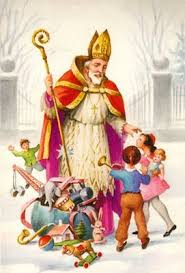
Will the real Saint Nick please stand up?

(Conversations with Jeffrey--The Series)
https://encrypted-tbn3.gstatic.com/images?q=tbn:ANd9GcSbhFfute5f6OoSyIg1Yh_q5NiNONQ0P3JvflEgdMbBsJYR9B69

“Jeffrey, you believe in Saint Nick, right?”

Grandma, remember I'm 13 now!”

“I mean the real one, the flesh and blood man whose Feast day is December 6 and celebrated by Catholic Christians all over the world.”

Don't you mean December 25th and Santa Claus?”

“Nope. At Christmas we celebrate the birthday of Jesus, although we don't know the exact date or year of our Savior's birth. I mean Saint Nicholas, a bishop of the Church, a real historical figure who lived at the turn of the fourth century.”

Exactly where did he live? I'm guessing it wasn't at the North Pole?”

“In Asia Minor in what is now Turkey, but it was a Greek province at the time. It isn't far from the Holy Land, Israel, just across the Mediterranean sea.”

So there really was a Saint Nick?”

Absolutely. Catholic Christian Churches around the world still honor Saint Nicholas as the generous, model bishop who put Jesus Christ at the center of his life, his ministry, and his entire existence.”

But where does the name 'Santa Claus' and his story come from?”

'Santa' means 'saint' and 'Claus' came from shortening the bishop's name 'Nicholas.' Some say that early Dutch settlers in New York brought their tradition of 'Sinter Klass' to America and that started the tradition here.”

Tell me again what a 'saint' is?”

The word 'saint' means 'holy.' Saints are just ordinary people who want to live like Jesus taught us to live, but they are special because they did a good job at it. The apostle Paul calls all Christians 'saints' in his writings.”

They're sort of like Catholic Christian heroes, right? Like role models?”

That's the idea. We consider them examples of how we too should live pleasing to God. Because they are still alive in Heaven, no matter how long ago they lived on earth, we can ask them to pray for us.”

What connection does this real Saint Nick have to the Santa Claus story today.”

“The Santa Claus story sort of grew in people's imaginations through the centuries since the real man lived who was named Nicholas, the Bishop of Myra, a southern seaport in Turkey. Even the way the modern Santa Claus is dressed came from the real Saint Nicholas. Bishops of the Church always wear red and Nicholas was a bishop. Today's Santa and his 'helpers' are always dressed in red. Starting in 1931 (when Grandma was only six years old!) the Coca-Cola company started using a caricature of the real Saint Nick for their advertising.”

What's a 'caricature'?”

“It's like a cartoon, an artist's way of exaggerating certain features of the real person.” 

Do we know anything about Nicholas as he was growing up?”

“Nick was the only child of very rich parents who died in an epidemic when he was a young boy. He grew up in a monastery and became a priest when he was 17. He inherited his parents' wealth and used all of it to help poor families, widows, and especially children and orphans. He became famous for his generosity and kindness and giving of gifts.”

How long after Jesus' resurrection did Nicholas live?”

“About 280 years. The Christian Church was just getting started, but faith in Jesus was spreading fast all over the known world of that day. During Nicholas' life the leader of the country, Emperor Diocletian tried to destroy the Church with his political power. One of his advisers was the son of a witch. The Emperor worshiped pagan idols, burned writings about Jesus, and forced priests to renounce the Christian faith or face death. He forbade Christians to meet together or hold any government office. As a bishop and their leader, Nicholas was the main target for his persecution.” 

Did this stop Bishop Saint Nick and all those new Christians?”

“The emperor arrested him and had him tortured for disobeying the new laws. Actually, the real Saint Nick must have been very skinny, unlike today's Santa. He spent more than a decade in prison being starved and also fasted often when he was free. Emperor Diocletian was eventually defeated, and his kingdom collapsed. Constantine, who became the next emperor, was favorable to the Christians, so Saint Nick finally got out of jail.”

Did everything go smoothly for the Christians then?”

“There was trouble. Some who called themselves Christians but didn't believe exactly what Jesus and His apostles taught caused confusion. Nicholas was known for his courage to stand firm for the true Christian faith. He lived it and taught his people well. He was against the heresies of those times.”

What's a heresy?”

“It's a teaching that is contrary to what Jesus and his followers clearly taught. The main heresy in Nicholas' day was led by a man named Arius from Egypt. He tried to convince people that Jesus was not really the Son of God, maybe just a prophet or only a top angel—'sort of a lord' but not equal to God.”

How did that all get settled?”

“In those early first centuries after Jesus' resurrection when all the new Christians were forming their common beliefs, they settled important matters of the Christian Church by calling a Council of all the bishops. The first one ever was called by Emperor Constantine during the time of Bishop Nicholas. It was held in Nicea in 325. More than 300 bishops from all over the Christian world attended, including Nicholas. Their conclusions are what we declare in the Nicene Creed that we say every Sunday at Mass.”

Did our Saint Nick stand up against this Arius fellow?”

“Bishop Nick got so angry with Arius at the Council for saying such things about Jesus, that he belted him—he hit him with his fist and knocked him down!”

Wow! What happened to Saint Nick?”

“For doing that, the Emperor took away his vestments and his bishop's credentials and threw him in prison. The story goes that Jesus and his Mother appeared to him in a vision in prison and reinstated him as the bishop.”

What kind of gifts did our Saint Nick give to people?”
“Legends say that Saint Nick always wanted to help people anonymously. He didn't want to draw attention to himself. On one occasion he heard that a certain poor man had three daughters who wanted to be married. But their father didn't have money for a dowry so Bishop Nick secretly helped him out.”

What's a dowry?” 
 
“In those early centuries, a young woman's father had to offer a prospective husband something of value called a dowry. Without a dowry, she was not likely to marry and might have to be sold into slavery. On three different occasions, so the story goes, Saint Nick threw gold coins through their windows where they landed in stockings hanging by the fireplace to dry.”

Could that be where the custom of filling stockings at Christmas came from?”

“Probably. He is also known for saving three innocent condemned prisoners who were blindfolded and ready for the executioner's sword. Nicholas fearlessly grabbed the sword, cleared them of the unjust charges, and the men went free. Saint Nick is widely known as the patron saint of children. There are other stories of him rescuing children from danger after they were kidnapped or missing. There is a scary one about three little children lured into the clutches of an evil butcher. At another time three theological students were murdered by an innkeeper and their bodies chopped up and hidden in a pickling tub.”

That's gross, Grandma. Is it true?”

“Who knows? Stories grow bigger with the retelling. Saint Nick was said to have restored the dead students to life. He had a strong concern for justice, especially for innocent condemned prisoners. Also for intervening in favor of people unjustly jailed, which was common in those days.”

He must have been quite an aggressive man.”

“You could say that, but it was always to defend the true faith of Jesus. The real Saint Nick also destroyed many shrines to pagan idols, drove the demons away, and built churches in their place. He so totally destroyed the most beautiful and famous pagan temple dedicated to the goddess Artemis, who was the Roman equivalent of the Greek goddess Diana, that not one stone was left in place. Thousands of churches all over the world are named in honor of Saint Nicholas.”

Did Saint Nick ever get to the Holy Land?”

“He went there on a pilgrimage. On his way back, the story goes that the ship he was on and the sailors were protected when he prayed, like Jesus did, for God to calm the storm. Many seaports especially in Greece, since Nicholas was Greek by birth, erected statues of him surrounded by small ships made of silver or carved from wood. Sailors even now ask him to pray for their protection. Instead of wishing one another luck, they say, 'May Saint Nicholas hold the tiller.'”

Is Dec. 6th Saint Nick's birthday? How did the idea of giving gifts get shifted to December 25th ?”

“Dec. 6 is the day he died. Saints' days are always commemorated on the day of death, the happy day of their entrance into eternal life. In Europe it was on Saint Nicholas' day when gifts were given. At that time gifts were mainly nuts, apples, and sweets put into shoes left beside beds, on windowsills, or before the hearth.” 

Where did the idea come from that Santa comes down the chimney?”

“Well, that certainly didn't come from the days of the real Saint Nick. Did you know that chimneys weren't even built on houses in those days? Chimneys didn't come into use until the 13th century when they were constructed in northern Europe.”

A lot of the early Santa pictures you showed me have a hooked staff behind him in the sleigh. What's that all about?”

“That custom did come from our real Saint Nick. It is called a 'crozier' and is always carried by a bishop even now in our Churches. It represents a shepherd's staff since a bishop is to be the shepherd of his people, as Jesus is the Good Shepherd.”

Bishop Loverde carried a crozier like that when he conducted our Confirmation Mass.”

Did you notice that in some pictures of Santa today he is carrying a big book? In some European gift-giving traditions the large book represents the record of children's behavior—Santa is checking if they were 'naughty or nice.' But the big book we see at Mass from which the priest or the lector reads is the Book of the Gospels or the Holy Scriptures.” 
 
For today's Santa, where did the idea of the sleigh and reindeer come from?”

“It took generations before the tradition settled on Santa coming on Christmas to bring gifts. In 1821 the first, small, lithographed book was published in America titled The Children's Friend. A 'Sancte Claus' (in German, 'Sankt Nicklaus') was pictured with a red beard arriving from the North in a sleigh pulled by one sort of exhausted-looking flying reindeer. They were shown landing on a roof by a chimney. Santa began to be thought of as rewarding good behavior and punishing bad. Gifts were mostly safe toys, dolls, and books. The sleigh even had a bookshelf! From then on the tradition shifted away from the real Saint Nicholas celebration to Santa coming on Christmas eve.”

Grandma, that long-ago picture shows Santa as a tiny man not the big guy in pictures we see now.”

“That was still the idea two years later when Clement Clark Moore wrote the poem 'The Night Before Christmas' for his six kids. The way the author imagined Santa was 'chubby and plump, a right jolly old elf' and his sleigh was miniature. The description stuck and the poem became famous.”

Where did that long clay pipe and all the smoke Santa blew from it originate?”

“The traditional pipe was from the Dutch, who were known to be heavy smokers. It wasn't until the end of the 1920s (when Grandma was in kindergarten!) that the American Santa began to be pictured as a normal-sized old man but with a hugely fat belly.”

And his original red beard has became all white and long to match the fur trim on his suit. He has a fat, white mustache, rosy cheeks and twinkling eyes.”

That's the way the story goes. And he wears snow boots, a wide black belt, and a long-tailed ski cap. But Bishop Saint Nick's hat was called a 'miter,' the special tall, pointed hat of his appointed office.”

And I guess he likes Coca-Cola, or hot chocolate, and cookies that people leave by the fireplace for him!”

“Now he owns eight reindeer (nine, if you count the new Rudolf with the red nose!) and a bunch of elf assistants who are busy making toys all year. And the toys are really high-tech now!”

That doesn't sound much like our original Saint Nick.”

“Santa Claus, for some, replaces the Babe of Bethlehem; the real Saint Nick points us to the real Babe of Bethlehem. 
Today's Santa is pictured as flying through the air from the North Pole; Saint Nick walked the earth caring for those in need. 
Santa, as we know him, was brought on the scene to boost commercial Christmas sales; Saint Nicholas brought the message of Christ and peace, goodwill toward all—the real Christmas story. Santa belongs to childhood fantasy; Saint Nick is still a Christian model for all of us.”

Wednesday, December 5, 2012

Counting on my Catcher

Practice makes perfect--TRUST

Trapeze artists offer a beautiful image of trust. Flyers have to trust their catchers. They can do the most spectacular doubles, triples, or quadruples, but what finally makes their performance spectacular are the catchers who are there for them at the right time in the right place. Much of our lives is flying. It is wonderful to fly in the air free as a bird, but when God isn’t there to catch us, all our flying comes to nothing. Let us trust in the Great Catcher.     
Fr. Henri Nouwen

And God inspired Saint Paul to express it in this reassuring way:
“And we know that in all things God works for the good of those who love him, who have been called according to his purpose. For I am convinced that neither death nor life, neither angels nor demons, neither the present nor the future, nor any powers, neither height nor depth, nor anything else in all creation, will be able to separate us from the love of God that is in Christ Jesus our Lord.”
Romans 8:28, 38 – 39

Trust is a hard and difficult concept for me. Maybe it stems from my childhood or maybe from aging or being gun shy after many failures. Or maybe it is from my own reality as a person as I am learning, re-learning and unlearning many things about the life, the heart, faith and God.

Trust has to do with relying on the integrity of Someone or something, like when I drive across a bridge I trust that the structure will hold. But trust in the seen is a far cry different from trusting in the Unseen.
I trust Jesus, I do, but I am human and in my more humane moments, my trust is fragile, even in the face of evidence to contradict my lack of trust and faith. Time and time again God has shown himself in love and tenderness by meeting needs and pouring out Grace in my darker, more fragile moments.

Trust is indispensable to faith in Jesus. I must trust Jesus at his word, even though I cannot see him face to face in his bodily form. But with trust, I do see Jesus daily: in the eyes of wounded people facing their pain boldly and head on; in the distressing disguise of the poorest of the poor; in the sentient beauty of the mountains that surround my world; in my quiet moments. I do see the Word become flesh and in and around me daily.

Trust comes when I ask for the eyes to see in the dark, my own darkness to be precise, the glory of the Lord and his love.

Trust comes when I pray for wisdom and then without thunderbolts and lightening, I simply make a choice, trusting that God is working deeply in the midst of my choices, regardless of whether I see or feel God.

Trust comes when I take leaps of faith. It is knowing that when I risk all, one of three things will happen:
either I will be caught when I fall;
 I will sprout wings to fly;
 or I will not be broken if I land too hard.

Trust is accepting God's unconditional love. It is saying to God, “I know You love me, like no other, and You will always be there…You will never forsake me, even if I forsake myself.” Trust is knowing Jesus says to me daily, “I will never, ever, leave you or forsake you.”

                   Guest post from “Earthy-monk” (Excerpts)